︎

︎Home 

︎Catalog
︎New & Forthcoming
︎Cartonera   
︎Submissions   
︎Support   
︎About   
︎Contact


︎  ︎

Founded in 2014, Cardboard House Press is a space for dialogue between poetics that investigate social, environmental, political, cartographic and linguistic formations. Cardboard House Press publishes poetry in translation in the United States by Latin American and Spanish authors and prints books through diverse processes, including letterpress, block printing, stencil, screenprinting and digital. A series of our publications are made by hand in community workshops. All our books are bilingual.


︎Newsletter


Mark

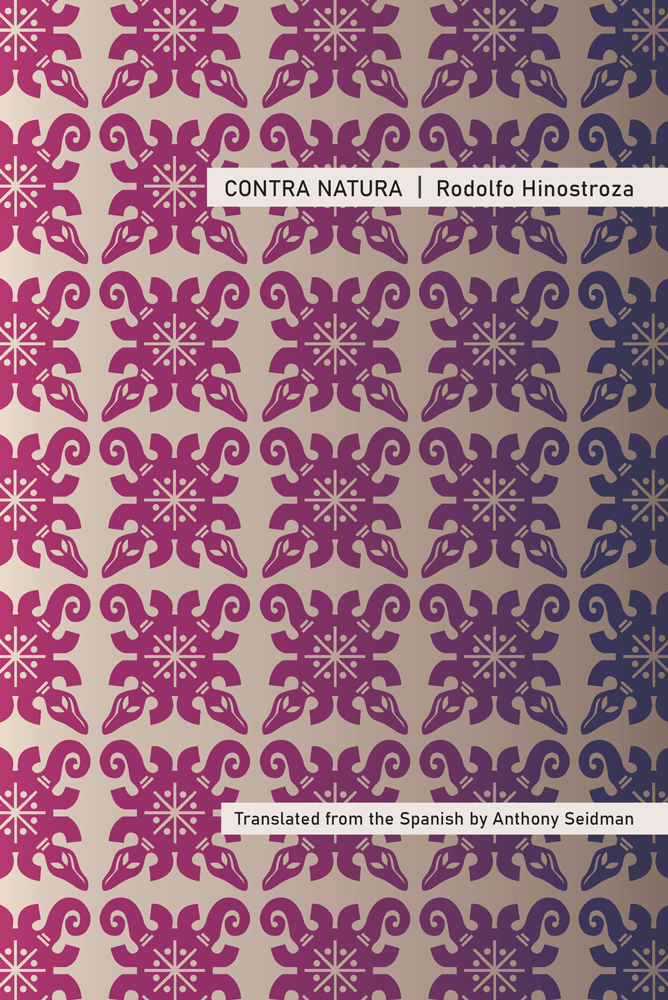
Contra Natura

Rodolfo Hinostroza

Translated from the Spanish by Anthony Seidman

Design by Mutandis

Poetry
Bilingual edition
Paperback
124 pages

ISBN 978-1-945720-25-3
February 22, 2022


Contra Natura is supported in part by the Witter Bynner Foundation for Poetry.


The work of Rodolfo Hinostroza carries us into a world of physical & spiritual poetry at its limits & beyond: a further gift from the Southern continent in line with the likes of Vallejo, Huidobro & Neruda, & no less powerful for all its late emergence. For those of us who want & need the fullness of a poetry unfettered, Contra Natura takes its place as one of our new essentials—a ripeness & overabundance for which I’m truly grateful.

—Jerome Rothenberg


Kinetic, defiant, exuberant, furious, libidinous, and thunderously alive, Contra Natura is an interdisciplinary tour de force: a restorative, transformative riot in which world history, current events, languages, literature, astrology, and mathematics are radiantly fused in Rodolfo Hinostroza’s kaleidoscopic lens. Anthony Seidman’s translation is a marvel: attentive, inventive, agleam.

—Robin Myers


The publication of Contra Natura, by the Peruvian poet Rodolfo Hinostroza in 1971—after having obtained the prestigious Maldoror Prize (1970), awarded by Barral editions, and judged by Octavio Paz—signified a major transformation in Latin American poetry, and in Spanish-language poetry at large. The book arrived with major expectations, garlanded with the same enthusiasm for other works within the great Western tradition ad portas of the XXI century. And indeed, Contra Natura—now in its first-ever presentation for the Anglophonic world, as translated by Anthony Seidman—proves to be the most influential book of poetry written in Spanish, on both sides of the Atlantic.

—Roger Santiváñez


"And by then Reality was/ an impetuous phantasmagoria” writes Rodolfo Hinostroza in “King’s Gambit.” The reference is to chess, but the speaker might as well be referring to the way in which the works in this unique collection render the real and the symbolic as inextricably embroiled. The poet of the hitchhiking, Acapulco Gold, “make love not war” generation partakes of the era’s vernacular as much as of the neo-baroque aesthetic. No learned reference is too learned; Karl Marx and astrology happily cohabitate in the same poem. Anthony Seidman’s translations ride the poems’ narrative momentum and are finely attuned to their living dialects. Here, when meeting its crystalline obverse, opacity dazzles. 

—Mónica de la Torre


“You know what, Hinostroza? That book is going to change your life. Believe me. Be patient, as that book is going to change your life.”

—Octavio Paz


Opacity’s rhythms dance on the horizon in Rodolfo Hinostroza’s Contra Natura. An essential work of the poetics of the Americas, a gift to English.

—Charles Bernstein


This lupine councilor, this Scorpio anti nature, this voluntary exile fomenting his crystalline humors in green fire: Hinostroza reminds us that “[a]nother world is ours.” Seidman’s new translucinations of this Peruvian troubadour are vital and explosive. If you don’t believe that “Life = More Life,” then Hinostroza is certainly not the poet for you. But if you give stones the benefit of the blood-pour, if you want to be immersed in androgynous abracadabras, if you understand Beauty as “[m]ediation / between the visible world and the possible world,” then by all means, here, kick these horse skulls across the beach with him. Contra Natura: every nameless thing in History has gathered for the “dialogue of the hundred veils and what they keep hidden.”

—Carlos Lara


 ABOUT THE AUTHOR 


Rodolfo Hinostroza (Peru, 1941-2016) is one of Latin America’s most celebrated poets from the 20th century. His poetry is noted for its vast sweep which includes astronomy, history, counterculture, alchemy, politics, all rendered in erudite, yet lyrical open sequences. He is recognized as a bridge between Vallejo and contemporary poets from Peru. His most acclaimed collection of poetry, Contra natura (1971), made an impression as indelible as Vallejo’s Trilce, and it won the Maldoror prize in 1970 with none other than Octavio Paz as presiding judge. Other publications by Hinostroza include Consejero del lobo (1964), the novel Fata morgana (1994), and the play Apocalipsis de una noche de verano (1988). He was awarded a Guggenheim in 2009 and Peru’s Premio Nacional de Cultura in 2013 for his life’s work. At the time of his death in 2016, he was revered by younger poets and was a central figure in the literary life of Lima.


 ABOUT THE TRANSLATOR 


Anthony Seidman is a poet and translator from Los Angeles. His translations include the novel For Love of the Dollar by J.M. Servin, and A Stab in the Dark by Facundo Bernal. Seidman’s most recent collections of poetry are Cosmic Weather and A Sleepless Man Sits Up In Bed. His poetry, translations, reviews, and short fiction have appeared in such journals and anthologies as New American Writing, Poetry International, World Literature Today, The Bitter Oleander, Modern Poetry in Translation, Ambit, and The Ecopoetry Anthology. Some of his poetry has been translated into French and Spanish, with versions appearing in literary magazines from Mexico, Chile, France, and Argentina.