
︎

︎Home 

︎Catalog
︎New & Forthcoming
︎Cartonera   
︎Submissions   
︎Support   
︎About   
︎Contact


︎  ︎

Founded in 2014, Cardboard House Press is a space for dialogue between poetics that investigate social, environmental, political, cartographic and linguistic formations. Cardboard House Press publishes poetry in translation in the United States by Latin American and Spanish authors and prints books through diverse processes, including letterpress, block printing, stencil, screenprinting and digital. A series of our publications are made by hand in community workshops. All our books are bilingual.


︎Newsletter


Mark

Red Seed: Poems for Luno
Tsitsokgo talhtsí: kamaxanatliw papa'
Semilla roja: Poemas para Luno


Cruz Alejandra Lucas Juárez

Translated by Wendy Call and Whitney DeVos
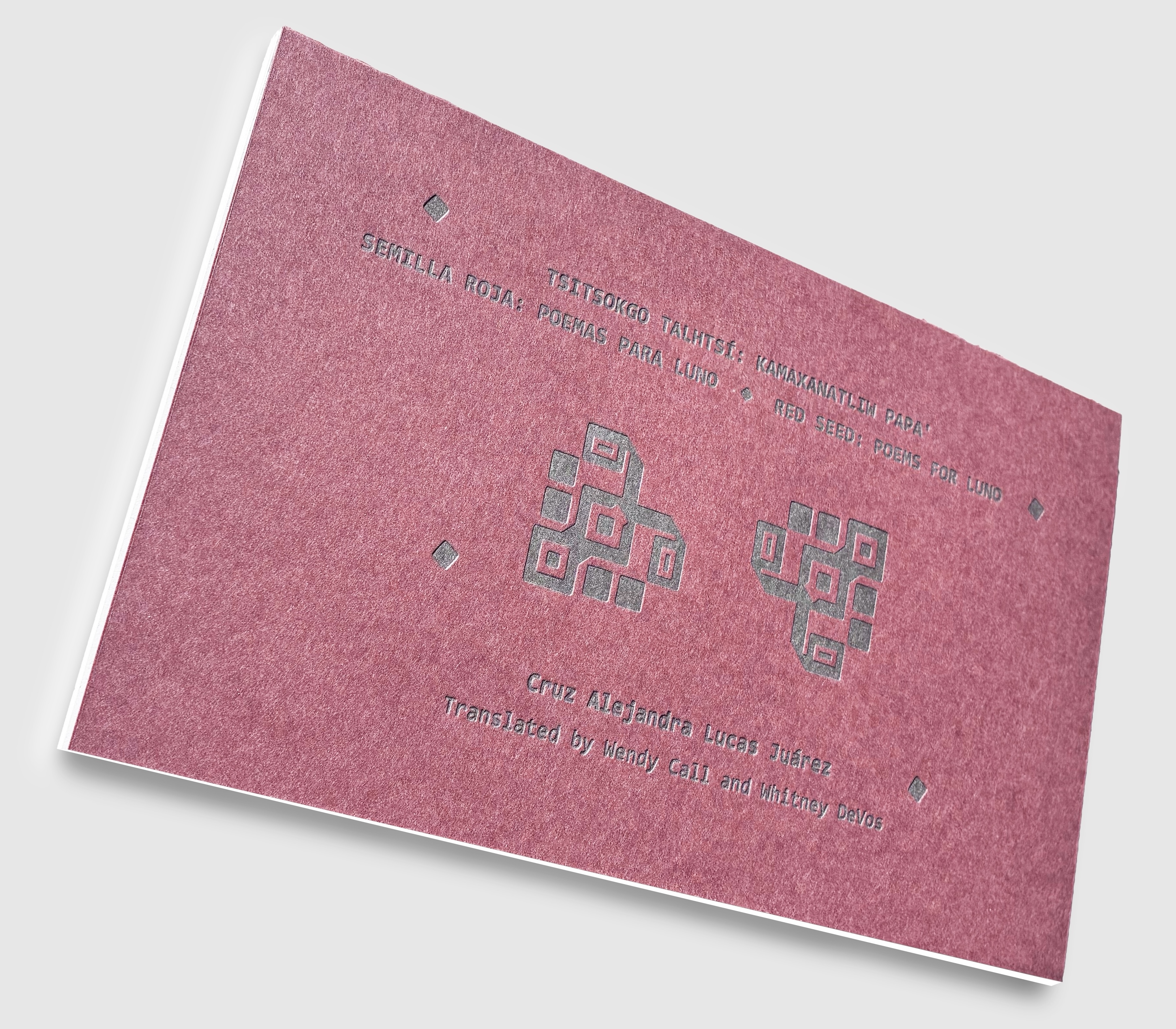
Mexican poet Cruz Alejandra Lucas Juárez is the first woman to publish a bilingual Tutunakú-Spanish book of poetry; this trilingual chapbook draws from Xlaktsuman papa’ / Las hijas del Luno (2021), her debut poetry collection. The subtitle, “Poems for Luno,” uses the masculine version of the Spanish word for moon (the feminine “luna”), referencing the Tutunakú belief that the moon (papa’) is the metaphorical father of all women. Papa’ / Luno bestows the gift of their womanhood, as regulator of the menstrual cycle; his monthly arrival is characterized as an amorous affair. This erotic relation is celebrated in Lucas Juárez’s poems, which weave together images of Luno as he appears to the speaker—and to her maternal ancestors—in dreams, quotidian moments, and Tukunakú stories.


---
Poetry | Chapbook | 48 pages
Tutunakú | Español | English
March 6, 2026 | ISBN 978-1-945720-41-3
Designed by Mutandis
Covers letterpress printed with Bidon Community Print & Design Studio

The publication of this book was made possible thanks to the support of the Poetry Foundation


 Praise 


Through a voice at once intimate and collective, Lucas Juárez expands the powerful presence of Tutunakú roots to open up territories and to interweave desirous bodies, dream relationships, and the memories of women ancestors. This beautiful translation by Wendy Call and Whitney DeVos, in a precious handmade edition, affirms the trilingual (Tutunakú, Spanish and English) as an ethical strategy of listening to and translating the world. Red Seed collects twelve poems of women's sexualities and spirits in which body, language and territory are political spaces that Indigenous memory expands within and renews.—Maricela Guerrero, author of The Dream of Every Cell


 Author 

Cruz Alejandra Lucas Juárez is author of the bilingual Tutunakú-Spanish poetry collection Xlaktsuman papa’ / Las hijas de Luno (2021). Originally from Tuxtla, Zapotitlán de Méndez, Puebla, Mexico, she studied language and culture at the Intercultural University of the State of Puebla. In 2022 she received her second fellowship from the prestigious National Fund for Culture and the Arts (FONCA), in the category of poetry in Indigenous languages. Her comic Laktsuman xla kuxi’ / Mujeres maíz, which won fourth place in a nationwide contest for comics in Indigenous languages, was published by Mexico’s National Institute of Indigenous Languages (INALI). She works as a Tutunakú-Spanish translator, offers workshops and courses in creative writing, and has organized forums for the dissemination of literature in Indigenous languages.
 

 Translators 

Wendy Call is author, co-editor, or translator of nine books. Most recently, she translated Irma Pineda’s Stolen Flower (Yale University Press, 2025) and co-translated the award-winning How to be a Good Savage and Other Poems, by Mikeas Sánchez (Milkweed, 2024). She is currently writing a book about sense of place and co-edits Best Literary Translations, published annually by Deep Vellum. She lives in Seattle, on Duwamish land, and in Oaxaca, Mexico, on Mixtec and Zapotec land.

Whitney DeVos is a scholar, translator, and editor based in Mexico City. She specializes in the literatures of Abiayala/Afro-/Latinoamérica, focusing on poetry and its relationship to the state. From the Spanish, she has translated or co-translated four collections of poetry and three chapbooks. Much of her current work focuses on lenguas originarias, the Indigenous languages of the Americas, and has received support from the National Endowment for the Arts, Cornell’s Institute for Comparative Modernities, and MacDowell, among other places. She is coeditor of Ruge el bosque, a series of plurilingual ecopoetry anthologies, and producer of the experimental podcast Ecoteca, each aimed at a global Hispanophone audience.


 Review 


The depth of Lucas Juárez’s poetry stems from her close attention to the inventiveness of her own language (...) Given that the Tutunakú language is so dependent (and determined) by physicality and embodiment, it is worth highlighting the precision and creativity of Call and DeVos’s translation, which manages to preserve the beauty of Lucas Juárez’s poetry while imbuing the English translations with a life of their own.—Alejandro Beas-Murillo, Adroit Journal