![]()
Anthem of Evaporated Tears
El deber del pan
Xavier Valcárcel de Jesús
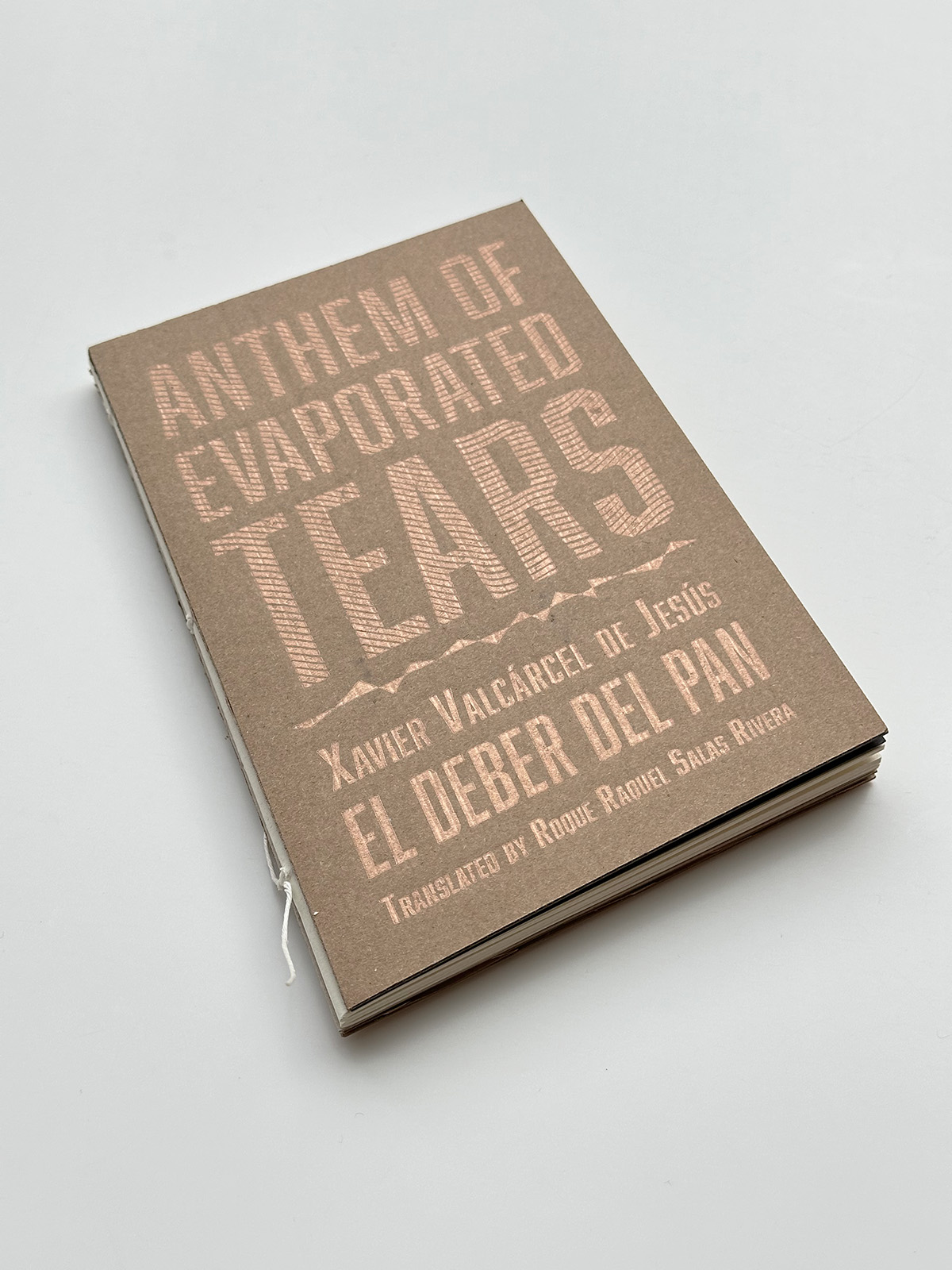
Translated from the Spanish by Roque Raquel Salas RiveraA concentrated and intense serial poem, Anthem of Evaporated Tears (El deber del pan) exemplifies the poetics of the elemental that characterizes Xavier Valcárcel's work, this time focusing on the generative qualities of fire's most destructive potentialities. Inspired by Virgil's Aeneid, the collection turns to face the violence at the heart of domesticity and gender, which is reconfigured by the poetic voice and his mother. Their mutual disillusionment with men frees neither of their responsibilities, as they attempt to flee a home in flames by going on vacation to another Caribbean island. Far from their daily labors, they are forced to turn back and look at the ashes of the home they left in their wake, in order to make sense of the totalizing potential they have nurtured together. Bread, oversignified by literature and history, is a product of both care and gendered labor and, like the violence that forges it, becomes invisible through repetition. Valcárcel breaks down the base materials for its creation, adding his own grief, his mother’s, and the final ingredient: fire. This bilingual edition, translated by Roque Raquel Salas Rivera, breathes new life into a contemporary Puerto Rican classic.
---
Poetry | Cartonera Book | Bilingual edition
64 pages | ISBN 978-1-945720-39-0
November 6, 2025 | Designed by Mutandis
Covers letterpress printed with Shut Eye Press
The publication of this book was made possible in part by grants from the Community of Literary Magazines and Presses (CLMP) and the Poetry Foundation.
Part of the Cartonera Collective Series, these books include a letterpress cover and are made by hand in community workshops, using sewn binding with recycled cardboard.
Praise
Xavier Valcárcel’s El deber del pan struck me with full force upon publication—“changed” feels far too slight. Like many, I came to read it as a testament to a life lived and a life still living and set ablaze by our own conflagrations. In the conspiracy of translation, Roque Raquel Salas Rivera kneads Valcárcel’s violence and tenderness, its intimacy and flight, extending the book’s position as an indelible landmark in our literature. It sings with generous compassion, in English as it does in Spanish—not only with fealty, but with profound care. Here is the work of our hands, which nourishes us and must continue to feed. This book is sustenance and provocation, opening our eyes to the tender, brutal realities we carry within us, and through which we are made.
—Ricardo Alberto Maldonado, author of The Life Assignment
Author
Xavier Valcárcel de Jesús (San Juan, 1985) is a Puerto Rican writer, visual artist, and cultural activist. Along with Puerto Rican poet and translator Nicole Cecilia Delgado, he founded Atarraya Cartonera (San Juan, 2009), the first Cartonera project in the Caribbean. He has published eight books of poetry: Cama onda (2007), Anzuelos y carnadas (2009), Palo de lluvia (2010), Restos de lumbre y despedida (2012), El deber del pan (2013), Fe de calendario (2016), Helio (2022) and Quise beber morir soñando (2024); as well as the crónica Aterrizar no es regreso (2019). His work has been translated into English, German, and Portuguese. In 2021, he became one of the inaugural recipients of the Letras Boricuas Fellowship, granted by The Mellon Foundation and the Flamboyán Foundation’s Art Fund.
Translator
Roque Raquel Salas Rivera (Mayagüez, 1985) is a Puerto Rican poet and translator of trans experience. His honors include being named Poet Laureate of Philadelphia, the Premio Nuevas Voces, and the inaugural Ambroggio Prize. He is the author of eight poetry books, and has edited the anthologies Puerto Rico en mi corazón (Anomalous Press, 2019) and La piel del arrecife: Antología de poesía trans puertorriqueña (La Impresora & Atarraya Cartonera, 2023). His translations include The Rust of History (Circumference, 2022), a selection of the poetry by his grandfather Sotero Rivera Avilés, which was longlisted for the Pen Award for Poetry in Translation and ALTA’s National Translation Award, and The Book of Conjurations by Irizelma Robles, winner of the Sundial Literary Translation Award. His translation of Ada Limón’s poem dedicated to NASA’s Europa Clipper mission is currently on its way to Jupiter’s moon. His most recent book, Algarabía (Graywolf, 2025) is an epic poem that follows the journey of Cenex, a trans being who retrospectively narrates his life while navigating the stories told on his behalf. Salas Rivera teaches and writes in Puerto Rico.
Reviews
“Consider it the perfect literary companion for your next heartbreak, or for those days when the thought of lighting his favorite sneakers on fire feels like a completely legitimate form of poetic justice…Valcárcel excavates the home with the care of an archivist and the fury of an arsonist. He understands that the domestic is the first site of the colonial, the patriarchal, the place where the “burden of bread” (el deber del pan) is kneaded into our muscle memory…This is a deeply Puerto Rican and Dominican queer text, a chronicle from “this side of customs” (19). It maps the internal borders of identity, the hunger that is both physical and existential.”—Maria Burgos, CUNY Center for Puerto Rican Studies
“It is an anthem that is Puerto Rican, Latinx, and Caribbean to the bone. Mira, Boricuas have something of a knack for anthems. “En Mi Viejo San Juan.” “Lamento Borincano.” Héctor Lavoe’s “Mi Gente.” Bad Bunny’s “Nueva Yol.” Clemente Soto Vélez’s “The Blood That Keeps Singing.” Julia de Burgos’s “Song of the Simple Truth.” Pedro Pietri’s “Puerto Rican Obituary.” Our anthems blast oceanic across centuries. Perhaps we have such a legacy of powerful anthems in our music and literature porque when you are told you can’t be autonomous and that you are “foreign in a domestic sense,” it becomes necessary to craft ways to assert your personhood and agency that fall outside of Empire’s grasp. It is this legacy that Valcárcel de Jesús is drawing from and contributing to with this collection.”—Vincent Toro, Intervenxions, The Latinx Project
“Anthem of Evaporated Tears packs into one poem the elements of nature—fire, water, earth, and air—and, into one suitcase, the ingredients of el deber del pan—egg, salt, flour, and waves—as it narrates an intergenerational break-up story—with all the frustrations and violence that domesticity and dependence cause in a spirit that wishes to fly free…The translation by Roque Raquel Salas Rivera, author of the epic poem Algarabía, is masterful.”—Giannina Braschi, Latino Book Review
Anthem of Evaporated Tears captures the contradictions inherent in human relationships, including tenderness, anger, love, reflection, stubbornness, violence, and care. The work complicates these dichotomies by considering the entanglements of love and violence within patriarchal systems (...) Within these pages, Xavier Valcárcel de Jesús envisions the futures that emerge when one courageously chooses oneself over societal expectations. Doing so makes it possible to push past the silences and suffering, and move forward, even when the evaporated tears cling to the air.—Ariana K. Costales-Del Toro, The Poetry Project
The family home stands both as a space of healing and a symbol of colonial and heteropatriarchal rule; Valcárcel is interested in exploring how the former can be a form of violence stemming from the latter — and how it is the mother who often bears this bur- den. Put differently, the collection is invested in exploring the contours of motherhood — what it means to mother and be mothered under conditions of coloniality and in the shadow of heteropatriarchal violence.—Alejandro Beas-Murillo, Wasafiri